
Dr. Tobias Janoschka – Jena Flow Batteries
Name: Dr. Tobias Janoschka
Comany & Position: CTO of Jena Flow Batteries
Bio: Founder of JenaBatteries GmbH, a pioneer in organic flow batteries, in 2013. His professional portfolio is enriched with 30 scientific publications, awards, and numerous patents.
This interview with Dr. Tobias Janoschka, CTO of Jena Flow Batteries explores insights into one of the company’s latest projects: The world’s largest aqueous organic flow battery energy storage system in Ordos, Inner Mongolia, China.
Could you start by introducing Jena Flow Batteries and its mission in the energy storage landscape?
Jena Flow Batteries is a German provider of industrial stationary flow battery systems. Our company provides access to clean, affordable and reliable electricity for everyone by offering long-lasting, long-duration energy storage. It enables the integration of renewables and reduces the dependency on fossil fuels.
What type of flow batteries do you produce in terms of chemistry?
Some years ago, we started developing metal-free, organic flow battery systems, which are water-based and particularly well suited for frequency regulation and long-duration applications. With our new parent company Suqian Time Energy Storage, we combine German engineering and core intellectual property with gigawatt hour-scale production capacity and strong R&D capabilities from China. With this partnership we can offer both metal-free organic flow batteries, and also other chemistries, including vanadium systems.
Regarding applications, for what purposes and services are your flow batteries used?
The range of use cases for our flow batteries is quite broad. Here in Germany and across Europe, our main focus is on long-duration energy storage. This includes applications such as coupling with photovoltaic and wind farms, increasing on-site self-consumption, peak shaving, and similar scenarios where flow batteries traditionally perform very well.
Our organic flow batteries also have low self-discharge, thanks in part to our high performance membranes. This makes them suitable not only for long-duration storage but also for applications that require fast response and continuously running pumps, such as frequency regulation.
This application is particularly compelling for China, where both coal-fired and renewable plants require more and more stabilising technologies that perform hundreds of short charge–discharge cycles every day. These cause substantial stress on conventional battery technologies like lithium-ion. While they show rapid aging, flow batteries are able to withstand the intensive cycling. That’s one of the key reasons flow batteries are particularly fit for frequency regulation.
Case study: World’s largest aqueous organic flow battery energy storage system in Ordos, Inner Mongolia, China
- Developed by Jena Flow Batteries’ parent company: Suqian Time Energy Storage Technology Co., Ltd., in close collaboration with Jena Flow Batteries
- Technological benefits:
- Over 20,000 charge/discharge cycles
- Non-flammable and safe to operate
- Free of heavy metals and fully recyclable
- Frequency grid services grid integration for wind and solar power
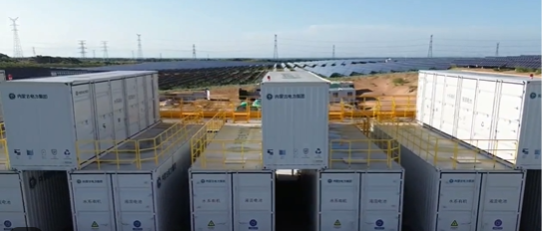
Can you please briefly introduce the innovative case study of the world’s largest aqueous organic flow battery energy storage system that Jena Flow Batteries helped develop?
The first-ever flow battery to use purely organic active materials was installed in 2019 by Jena Batteries in the Netherlands as part ofthe EnergyKeeper project.Since then, additional organic flow-battery installations have been employed, but they were typically small systems, around one megawatt-hour or below.
Now, we are very happy that in the summer of 2025, we contributed to install a 20 MWh organic flow-battery system in Inner Mongolia, in a city called Ordos, and it is now fully operational. The battery is connected to a solar farm and serves as the long-duration storage component alongside a lithium-ion battery. So it’s a large, fully integrated system that combines several storage technologies to buffer the green electricity produced by the PV installation.
This application demonstrates how the flow battery technology has evolved from something developed in the lab, starting with gram-scale organic materials, to producing such a large projects.
What did the timeline of the project look like?
This project in China was built within just a couple of months. From a European perspective, this is an extremely short timeline. While projects here are still waiting for all kinds of permits, storage projects in China move into implementation quickly. In this case, the fast schedule was also made possible because the system formed part of a larger installation, supported by major EPC partners who handled much of the integration work. I am confident that, with these projects now thoroughly tested abroad, similar installations will be realised in Europe in the upcoming years.
What was Jena Flow Batteries’ role in the implementation of the project?
Jena Flow Batteries provided the fundamental technology of the battery, which has been developed in Germany over the last couple of years. In essence, we contributed the core technology and the IP to make such a battery installation possible. However, without our parent company’s resources, expertise, technology, production capacity and networks in China, a project a project of this scale would not have been possible.
What would you say this project has achieved?
The battery is integrated with a PV plant and lithium-ion batteries, and together they function as a long-duration storage solution that enhances the reliability of the regional power grid. At around 20 MWh, it is a substantial installation for organic flow-battery technology. Indeed, it is currently the largest operating organic flow batteries in the world.
I would say that, beyond serving the regional power grid, the key function of this installation is its demonstration role. It proves that the technology is now ready to be scaled and put into application at the megawatt-hour level. There are projects in the 100-MWh range coming up soon, and this system was an essential step toward those larger installations.
The implications of the Ordos projects for the European Flow Battery and LDES markets
What would you say is the relevance of this project for the European energy market?
An important point to highlight is that this project uses an organic, metal-free, water-based flow battery. Unlike most stationary battery systems installed around the world, it doesn’t rely on any critical metals: no lithium, no cobalt, no nickel, no vanadium, and no rare materials. This truly sets the installation and the technology we developed at Jena Flow Batteries apart.
One can manufacture these organic salts on an industrial scale without critical raw materials. There are no exposure risks to price spikes or geopolitical constraints, as the chemistry is based on available bulk chemicals. As a result, the raw-material risk is low and end-of-life management becomes simpler. Even though this system was installed in China and the electrolyte was manufactured there, the same type of production could be set up almost anywhere. An identical chemical plant could be built here in Europe, for example.
During our development work, we collaborated with partners of various sizes across Europe who already understand how to manufacture these materials for flow batteries. Through these collaborations it became clear that localising the production of core elements of flow batteries in Europe is quite straightforward, especially when compared with more traditional battery technologies.
And of course, as it is true for many flow batteries, the systems are intrinsically safe and non-flammable because they use water-based electrolytes. They also offer long cycle life, making them especially well-suited for stationary applications.
In terms of best practices, how do you think European and national level incentives could accelerate the deployment of such organic flow batteries?
I believe that a lot of smaller, incremental actions can be taken, and together they may significantly help to advance technologies, not only organic flow batteries but energy storage technology as a whole.
Flow batteries are a great solution for long-duration energy storage, which will become increasingly important as more intermittent renewables are integrated into the grid. To ensure that these renewables can be absorbed without destabilising the grid, it would be sensible to adjust the environment across Europe, so it not only incentivises short-term power applications, but also actively supports battery technologies that are ready for LDES.
This could include dedicated auctions or capacity mechanisms for long-duration storage, focusing on 6 to 12 hours, or longer. The British capacity floor mechanism is one example. It would also mean supporting long-term contracts instead of short-term arbitrage models where batteries are deployed for 5 to a maximum of 10 years. Creating a framework that allows flow batteries to be installed as true energy infrastructure, with 15- or 20-year contracts or even more, would help.
Overall, we need to recognise all the technologies that are out there at the moment, and make sure not to become overly reliant on only some of them. There is a lot of applications for lithium-ion systems, but our society shouldn’t make itself dependent on a single technology. For large-scale battery projects, 100 MW and above, it could make sense to require that a portion, say 10–20%, uses alternative or emerging technologies. These could be flow batteries or others. Such an approach would help promising new technologies gain momentum.
One more point: Europe has a highly complex regulatory landscape, and simplifying it would be extremely helpful. There could be special pilot rules for emerging technologies that streamline permitting at all levels, including building codes, environmental permitting, recycling rules, and more. This would help avoid forcing pilot projects to comply with the full set of regulations designed for mature technologies like large-scale lithium-ion batteries.
Another example is the EU Battery Regulation. While it is a major step forward to have one integrated battery regulation for all European countries, the practical implementation is far more fragmented. Instead of establishing one EU-wide battery register, for instance, the regulation leads to the creation of many national registers. So, for smaller companies bringing new technologies to the market, things like that add complexity and create barriers.
The target should be simplifying the regulatory framework and implementing centralised rules that apply uniformly across Europe so companies do not need to navigate requirements on a national or regional level.
Do you have a final message you would like to share with policy makers, flow battery producers or customers?
We can see that some countries are advancing much faster in implementing new battery technologies across all sectors, and their time to market is far shorter than in Europe. While we are still navigating complex regulations, large-scale installations are already being deployed elsewhere.
My message is to simplify procedures and, in general, to be more open to taking calculated risks when significant opportunities arise, especially with new and emerging technologies.
If another member, would like to be featured on our website, please get in touch with d.twomey@flowbatterieseurope.eu