
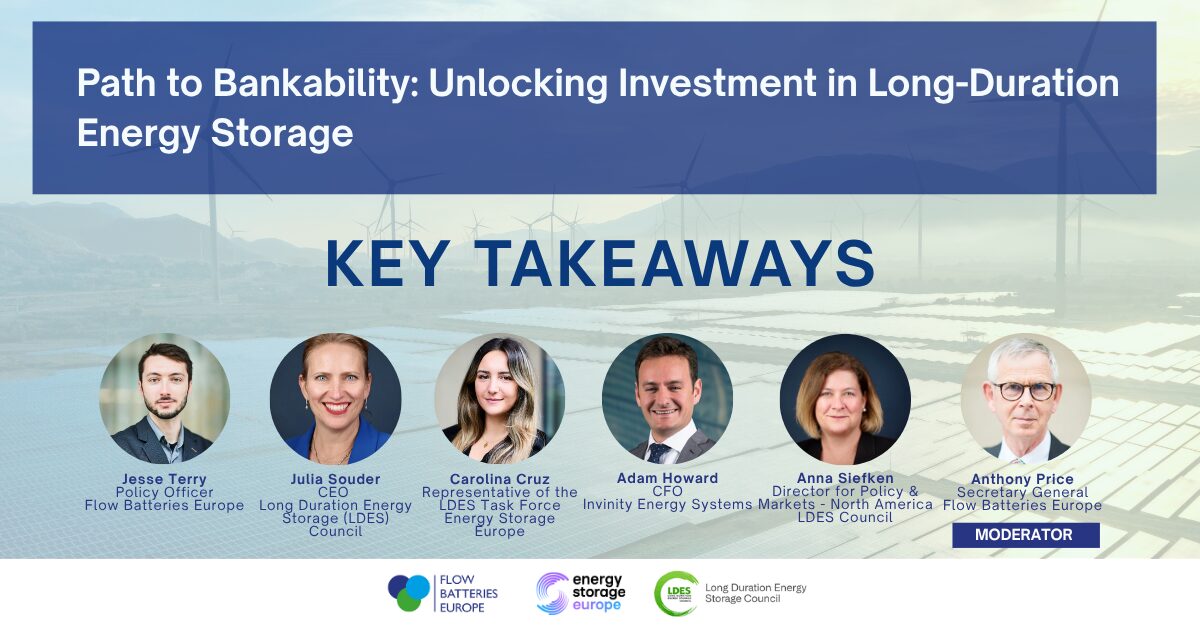
Flow Batteries Europe, together with the LDES Council and Energy Storage Europe, hosted a joint webinar on: “Path to Bankability: Unlocking Investment in Long-Duration Energy Storage“. It brought toFlow Batteries Europe, together with the LDES Council and Energy Storage Europe, hosted a joint webinar on: Path to Bankability: Unlocking Investment in Long-Duration Energy Storage. It brought together leading voices from policy, industry, and investment to address one of the sector’s most critical challenges: unlocking private capital at the scale needed for the clean energy transition.
Three presentations were followed by a moderated panel discussion attended by over 350 participants from across Europe and beyond.
Speakers & Key Highlights
Anna Siefkin, Director for Policy and Markets North America, LDES Council
- Anna presented the LDES Council’s latest report: Accelerating LDES Bankability. Read it here.
- The report identifies the core constraints to LDES scaling. It also highlights that bankability stands in the intersection of technological performance, risk allocation, capital markets discipline and revenue certainty. In addition, it was mentioned that private capital will not scale without a predictable cash flow and well thought risk management, regardless of system need.
Jesse Terry, Policy Officer, Flow Batteries Europe
- Jesse presented Flow Batteries Europe’s newly published report on: LDES Governance Best Practices. Read it here.
- The report highlights how fragmented the European policy landscape remains, from capacity mechanisms to double charging rules and time-of-use tariffs. It lists best practices into practical recommendations.
- The report calls for national and EU-level LDES targets to provide long-term visibility for investors, as well as targeted long-duration contracts (such as the UK’s cap and floor mechanism).
Carolina Cruz, Policy Officer, Energy Storage Europe (ESE)
- Carolina mapped out the main barriers still holding back LDES investment in Europe: markets that don’t properly reward duration, unstable revenue from grid services, and the compounding costs of taxation, grid fees, and slow permitting.
- On a positive note, she pointed to a series of emerging EU instruments: from the flexibility needs assessment process to the Clean Industrial Deal framework and the revised grids package, that could meaningfully shift the investment case for LDES, provided member states implement them well.
- ESE Report: Policy Options to Anticipate Europe’s Long-Duration Energy Storage Deployment. Read it here.
Discussion Takeaways
Moderated by Anthony Price, Secretary General of Flow Batteries Europe, the panel brought together Julia Souder (CEO, LDES Council) and Adam Howard (CFO, Invinity Energy Systems) alongside the three presenters for a wide-ranging discussion on what separates bankable LDES projects from those that never get off the ground.
The panellists agreed on the point that the policy and revenue certainty are the main ingredient missing, even though the technology is already proven and the system need is undeniable. The UK’s cap and floor mechanism was praised as a leading example of the need of a dedicated, long-term procurement framework to unlock project finance, crowd in institutional capital, and move technologies to commercial scale. Participants also discussed key differences between European and North American market structures, the need to drive domestic LDES deployment to satisfy national security considerations, and the necessity to value round-trip efficiency and other technical metrics holistically, not just individually.
View the webinar recording here.
Download the slides from the webinar here.