

30 January 2026:
Yesterday, Flow Batteries Europe hosted its most highly attended webinar to date, welcoming more than 230 participants to the session “Scaling Flow Batteries: Strategies, Trends and the Path to Grid-Scale Impact”. The discussion explored how flow battery manufacturers are moving from pilot deployments toward large, grid-scale applications, and what is required to scale successfully. A clear message resonated throughout the webinar: nothing needs to be reinvented. Proven industrial manufacturing approaches and infrastructure-scale deployment pathways already exist and can be applied to flow batteries today.
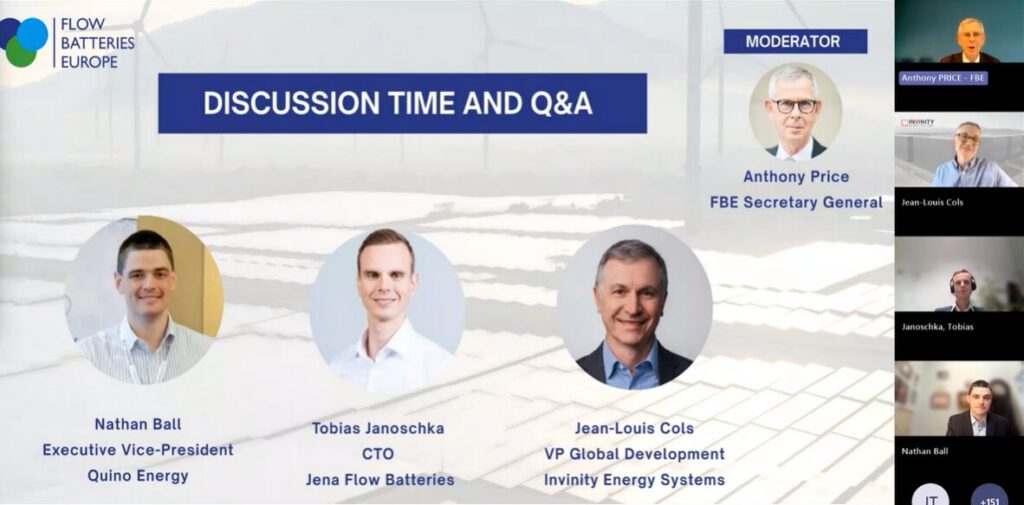
The webinar opened with a presentation by Nathan Ball, Executive Vice-President of Quino Energy, who highlighted how rapidly falling installation costs are reshaping the flow battery market. He pointed to a dramatic decline in costs from nearly USD 600 per kWh in 2017 to below USD 200 per kWh by 2025 as evidence that the sector is entering a new phase of commercial maturity. Nathan stressed that scaling flow batteries depends on the combination of technological innovation, such as advanced electrolyte system architectures, and strong industrial partnerships across the value chain. For this reason, Quino Energy’s strategy focuses on collaborating with established flow battery manufacturers and component suppliers that are already innovating and producing at scale, enabling new technologies to be deployed faster and more efficiently.
The second presentation was delivered by Dr. Tobias Janoschka, CTO of Jena Flow Batteries, who outlined the company’s journey from laboratory research to the world’s largest organic flow battery installation. He explained that Jena Flow Batteries chose to develop organic, metal-free flow batteries because organic materials are widely abundant, enabling a large-scale, low-cost and resource-secure value chain. He emphasised that scaling organic flow batteries is not only a matter of chemistry, but also of engineering, regulation and industrial integration. From early molecular screening and pilot systems to full product standardisation, Jena Flow Batteries has progressively built capabilities across the value chain, including stack, membrane, tank and component manufacturing. This deep integration culminated in a 20 MWh organic flow battery system deployed in Inner Mongolia, demonstrating that organic flow battery technology is ready for large-scale field deployment.
The final presentation came from Jean-Louis Cols, VP Global Development at Invinity Energy Systems, who shared key lessons from deploying vanadium flow batteries at increasing scale across multiple geographies. Jean-Louis emphasised that scaling must occur coherently across the entire value chain, from raw materials and electrolyte production to stack manufacturing, project development and grid integration. Invinity has now delivered projects ranging from a few MWh to more than 20 MWh, with systems operating daily to support national grids. He concluded that the transition toward flow battery systems delivering hundreds of MWh is already underway, enabled by standardised, cost-optimised products in series production, combined with industrial partnerships for key components such as vanadium electrolyte and cell materials.
The webinar concluded with a panel discussion that reinforced several key lessons. First, scaling is no longer primarily a technical challenge, but an industrial one, requiring repeatability, quality control, standardisation and predictability. Second, supply-chain maturity and material availability are no longer limiting factors for flow batteries, particularly for chemistries based on abundant or well-established industrial materials. Finally, the economics of flow batteries are already working, with project developers, utilities and investors showing growing confidence in the technology.
You can find the link to the webinar recording at this link, and the slides at this link.