


A new international research network is developing next generation porous electrodes for redox flow batteries, targeting electrodes that are up to 30 percent more powerful and up to 50 percent cheaper than today’s solutions.
The challenge
The energy transition has pushed demand for long duration storage solutions higher, and redox flow batteries are well placed to meet it, since they can store electricity from renewable sources for hours or even days and can scale storage capacity independently of power output.
Despite this advantage, redox flow batteries still carry a high levelised cost of storage and offer limited power density, largely because electrode use remains inefficient and components are rarely tailored to the specific needs of flow battery systems. These two constraints have held back wider deployment of the technology.
The results
The international research network SPACER, short for Shaping Porous Electrode Architecture to Improve Current Density and Energy Efficiency in Redox Flow Batteries, has been launched to tackle exactly this problem. Seventeen doctoral researchers from several countries are working together on a new generation of high performance electrodes for redox flow batteries.
The ambition behind the project is significant. The new electrodes are designed to be 20 to 30 percent more powerful and up to 50 percent cheaper than current solutions, while reaching energy efficiencies above 85 to 90 percent.
To get there, the research team is developing hierarchically structured multilayer materials that systematically optimise how electrolyte and current flow within the battery. This work spans three levels, micro, meso and macroscale, across the full development chain, from computer modelling that identifies optimal pore structures, to manufacturing using techniques such as stereolithography, 3D printing and textile technologies, to validation through high tech imaging methods that check prototypes against model predictions.
Industrial partner Pinflow Energy Storage will validate the new electrodes in near application test setups toward the end of the project, a key step toward reaching Technology Readiness Level 6. The results are intended for use across both established and next generation flow battery systems, including vanadium based technologies.
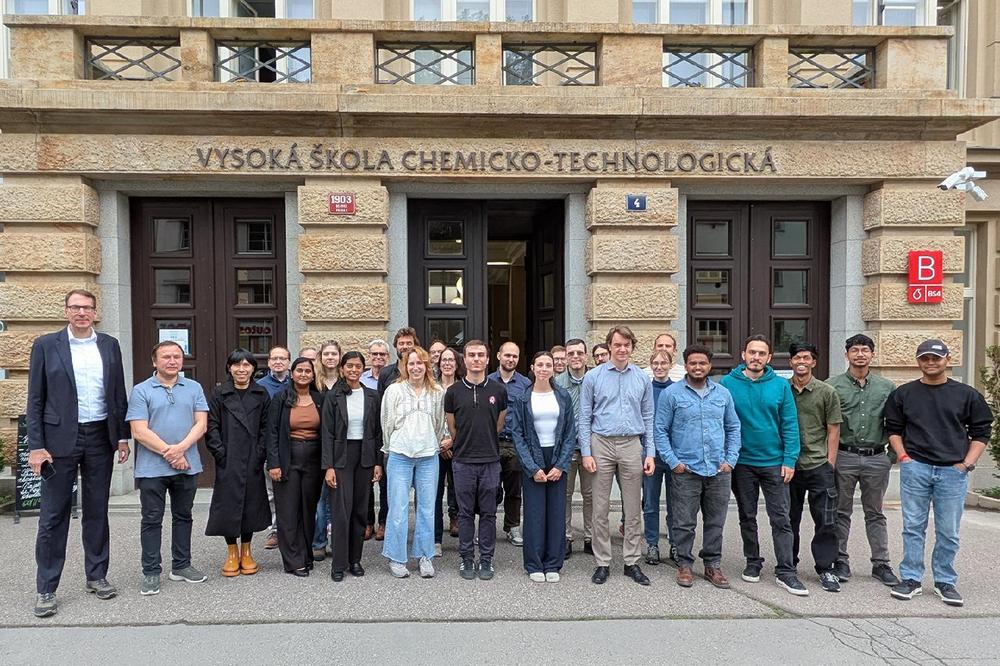
The first kick off meeting with the doctoral candidates took place from 9 to 11 June 2026 at the University of Chemistry and Technology Prague. Doctoral candidate Sritama Chakraborty of Fraunhofer ICT described the opportunity to research current flow battery technology and contribute to next generation prototypes as a chance to help make sustainable energy storage more accessible.
SPACER is led by the Fraunhofer Institute for Chemical Technology ICT and funded through the Marie Skłodowska-Curie Programme of the European Union. Beyond its technical goals, the network is also designed to prepare its doctoral candidates for future careers in academia or industry, with an interdisciplinary European consortium of companies and research organisations providing training in the skills needed to develop and integrate new models, materials and processes for electrochemical energy storage.
More information on the project is available at www.rfb-spacer.eu.